
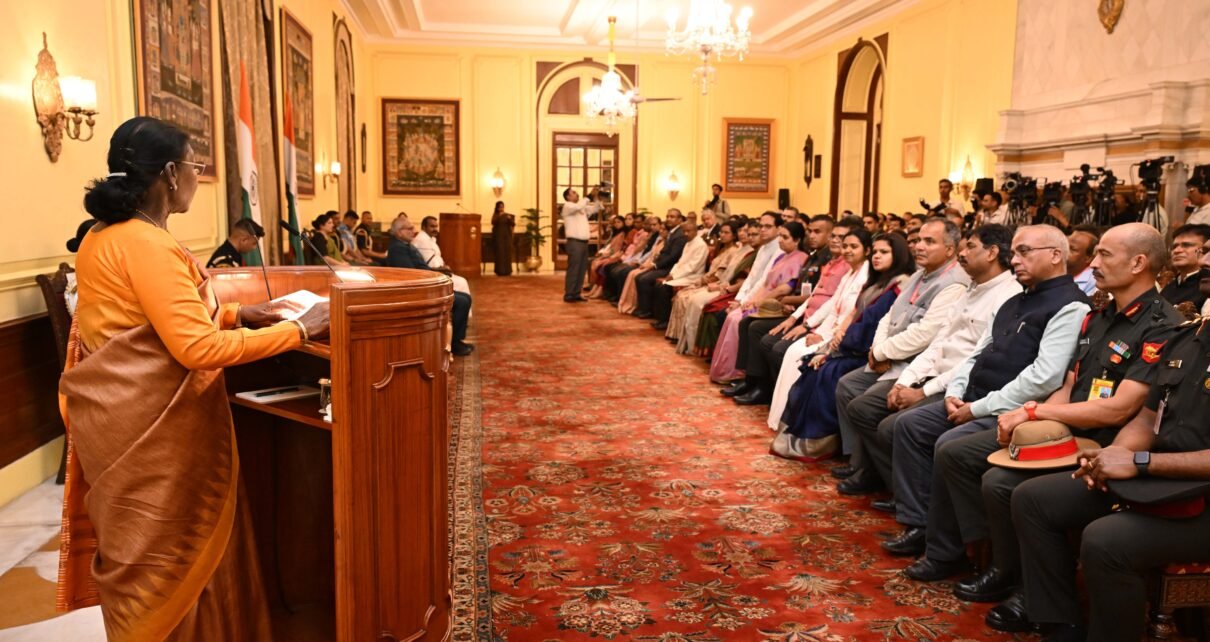
New Delhi: President Droupadi Murmu on Tuesday inaugurated and laid the foundation stones for a series of initiatives at Rashtrapati Bhavan and the President’s Estates to mark the completion of four years in office on July 25.
Among the key initiatives was the launch of an application-based e-Audio Guide for visitors to Rashtrapati Bhavan. The guide will be available in Hindi, English, and 14 other Indian languages, along with a sign language module to improve accessibility for all visitors.
The President also launched the third edition of e-Upahaar, featuring 300 curated Presidential gifts for public auction. The online auction will be open from August 5 to September 5, 2026.
A new ‘Bachpan Bal Parisar’ was inaugurated for children residing in the President’s Estate. The facility includes ‘Kilkari’, a dedicated play zone, and ‘Samarth Anganwadi-cum-Palna’, designed to provide a safe and nurturing environment for children’s care and development.
To promote sustainable and inclusive transportation, President Murmu flagged off RAAHI (Rashtrapati Bhavan Access and Heritage Interconnector), a fare-free electric bus service for staff and residents of the President’s Estate. Operated entirely by women drivers and conductors, the service aims to provide safe and convenient mobility, especially for women, children, senior citizens, and persons with disabilities.
The President also laid the foundation stone for a new service block under the Net Zero Energy Strategy, inaugurated accommodation facilities at Rashtrapati Niketan in Dehradun and Rashtrapati Nilayam in Secunderabad, and laid the foundation stone for the redevelopment of staff quarters within the President’s Estate.
Speaking on the occasion, President Murmu said Rashtrapati Bhavan continues to evolve as a vibrant symbol of India’s rich cultural heritage, democratic values, and national ideals. She noted that over the past year, several initiatives had been undertaken to promote India’s civilizational ethos, including the unveiling of a bust of Chakravarti Rajagopalachari, the inauguration of Param Vir Dirgha and Granth Kutir, the Indianisation of State Rooms, and greater representation of Indian art and traditions during State Receptions.