M. A Sudheer Babu, Pattambi, Agricultural Journalist
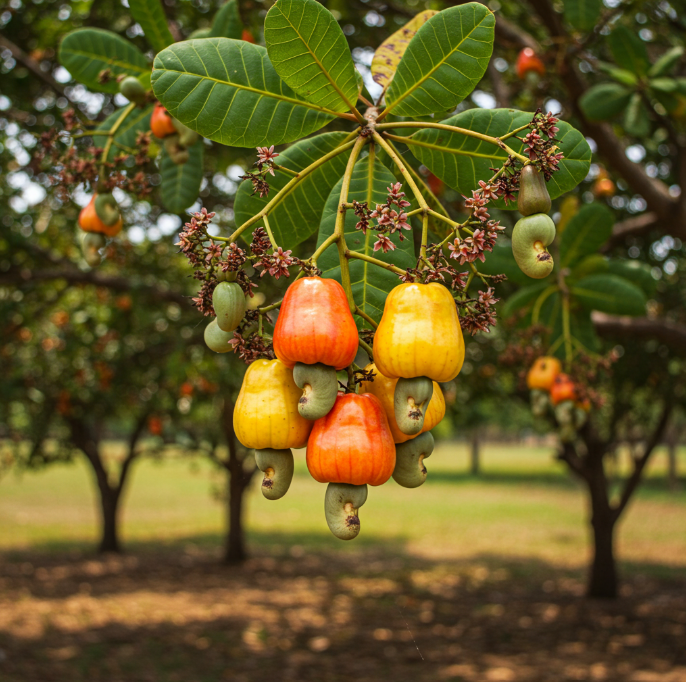
Cashew cultivation offers farmers a promising opportunity to generate good income with relatively low maintenance. Several high-yielding varieties suitable for different agro-climatic conditions are available in Kerala, according to M. A. Sudheer Babu, an agricultural science journalist.
Cashew, also known as the cashew apple tree or Anacardium occidentale, was introduced to India by the Portuguese. Initially planted in wastelands to prevent soil erosion, it has gradually emerged as an important commercial crop offering attractive returns.
Kerala has several improved cashew varieties developed by agricultural research centres, particularly the Kerala Agricultural University. Some of the notable varieties include:
Anakkayam 1: Released by the Anakkayam Centre of Kerala Agricultural University in Malappuram district, this variety has a compact growth pattern and dense branches. It flowers during October-November, with good nut development by December-January. Each tree produces an average yield of around 12 kg. Its cashew apple is pinkish-yellow in colour. It is suitable for most parts of Kerala except high-altitude regions.
Madakkathara 1: Developed at the Cashew Research Station in Madakkathara, Thrissur, this early-flowering variety has a compact growth habit. Its cashew apple is yellow, and the average yield is around 13 kg per tree.
Madakkathara 2: This late-flowering variety blooms in March and produces red cashew apples. The average yield is approximately 15 kg per tree.
Madakkathara 3: This variety is suitable for low-altitude plains but is not recommended for the high-altitude regions of Idukki and Wayanad.
Kanaka: Also known as Hybrid 1598, Kanaka is a hybrid variety that flowers during November-December. It has a medium flowering period and produces an average yield of around 12.8 kg per tree.
Dhana: Another hybrid variety, Dhana flowers during November-December and is harvested between January and March. It produces approximately 11 kg of nuts per tree, with yellow-coloured cashew apples.
Amrutha:This hybrid variety has a medium flowering period and produces its crop between January and March. Its average yield is around 18 kg per tree.**Sulabha:** A selection variety with late flowering characteristics, Sulabha produces approximately 22 kg per tree. Its cashew apples are light orange in colour.
Priyanka: This hybrid variety flowers during December-January and is harvested in February-March. Its cashew apples are yellowish-red, and the average yield is around 15-17 kg per tree.
K-22-1: Developed through selection, this variety flowers during December-January and is harvested in February-March. It produces approximately 13 kg per tree.
Vritachalam: An early-flowering selection variety, it flowers during November-December and is ready for harvest in January-February. Its average yield is around 12 kg per tree.
Raghav: This hybrid variety flowers during January-February and produces approximately 15 kg per tree. Its cashew apples are yellow.
Damodar: Another hybrid variety, Damodar is harvested during February-March.The Anakkayam research centre has also developed several other varieties.
Dharasree: A hybrid variety that produces yellowish-light red cashew apples.
Akshaya: This hybrid variety is harvested between January and March and produces approximately 12 kg per tree.
Anagha: Each tree produces an average yield of around 14 kg, with harvesting extending from February to April.Several other promising cashew varieties are also available for cultivation. Farmers are advised to select suitable grafted plants based on their local climatic and soil conditions.
Planting methods, pest and disease management, and fertiliser application are equally important for achieving better yields. These aspects will be discussed in a subsequent article. With suitable varieties and proper cultivation practices, cashew farming can become a promising source of income for farmers.