
M A SUDHEER BABU, PATTAMBI
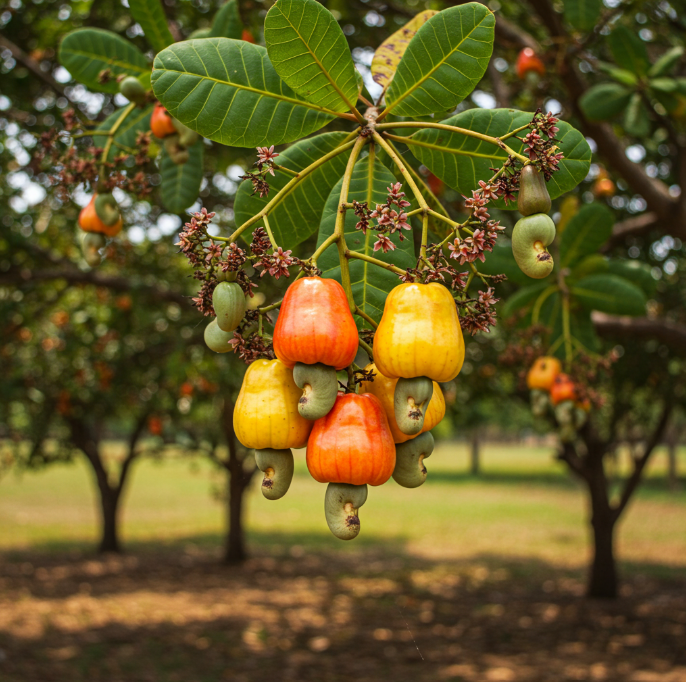
Cashew is often described as the “Golden Crop of Barren Lands”. It can grow well even in relatively infertile soils with limited care and produce a reasonably good yield. Traditionally, local varieties of cashew trees were widely cultivated. Today, several hybrid and dwarf varieties with compact growth are also available.
A model cashew plantation should be established in every panchayat with the support and financial assistance of the Agriculture Department. Such plantations would provide farmers with an opportunity to observe modern cultivation methods and learn best practices.
Cashew farmers can improve their income by utilising cashew apples instead of depending solely on cashew nuts. Proper collection, scientific storage and processing of cashew apples into different marketable products could create additional income opportunities.
The Directorate of Cashew and Cocoa Development under the Central Government and the Kerala State Cashew Development Corporation, along with other agencies, provide support for cashew cultivation and development.
Initiatives such as a Kerala Soil Health Mission and a Kerala Cashew Cultivation Mission could further strengthen agriculture through improved soil health and organised farming. Cashew farmers in each panchayat can be brought together through one or more farmer groups to coordinate cultivation activities, organise collective harvesting, store cashew apples scientifically, process them into various products and market them collectively.
Women in villages can also be trained in cashew apple processing through the Kerala Agricultural University. A sales outlet or marketing centre at the panchayat level could help them sell processed products and generate income.
Spacing and Selection of Saplings
In ordinary or relatively infertile soils, cashew saplings should be planted at a spacing of 7.5 metres in both directions, with 7.5 metres between rows and between individual plants.
In fertile, deep soils and coastal sandy areas, a spacing of 10 metres between plants is recommended.
Quality cashew grafts can be purchased from sales centres of Kerala Agricultural University, cashew research stations and Agriculture Department outlets. Grafted saplings are also available at several government farms across Kerala, including:
- District Agricultural Farm, Peringammala, Thiruvananthapuram
- Cashew Farm, Kottarakkara, Kollam
- District Agricultural Farm, Mavelikkara, Alappuzha
- District Agricultural Farm, Ernakulam
- Kerala Agricultural University Research Centre, Thrissur
- District Agricultural Farm, Chungathara, Malappuram
- Seed Garden Complex, Munderi
- District Agricultural Farm, Kuthali, Kozhikode
- District Agricultural Farm, Taliparamba, Kannur
- Cashew Nursery, Kasaragod
Pest Management
Major pests affecting cashew trees include tea mosquito bugs, stem borers, leaf-mining caterpillars, web-forming caterpillars that attack leaves and flower clusters, leafhoppers, hairy caterpillars and blossom thrips.
Farmers should follow the advice of agricultural officers and use recommended pesticides only in the prescribed quantities. Chemical pest control should be carried out responsibly and according to safety guidelines. Farmers can also adopt fully organic cashew cultivation practices.
Cashew Cultivation in Coastal Areas
Cashew trees are suitable for coastal areas, where they can help protect the soil. In coastal regions where coconut is the major crop, cashew trees can also be cultivated alongside Casuarina trees (Australian pine).
Cashew saplings can be planted during the rainy season. The best planting seasons are June-July and September-October. Open areas receiving adequate sunlight are ideal for cashew cultivation.
People with limited land can also grow grafted cashew plants in grow bags filled with a mixture of soil and organic manure.
Planting and Initial Care
For planting a cashew graft, a pit measuring 50 cm in length, 50 cm in width and 50 cm in depth should be prepared.
The pit should be filled with topsoil mixed with 10 kg of compost and 200 grams of rock phosphate. While planting, care should be taken to ensure that the graft union remains above the soil level.
The young plant should be supported with a stake to prevent damage from wind. Dry leaves and grass can be spread around the base as mulch to retain soil moisture. Regular light watering should also be provided to ensure proper establishment and healthy growth.