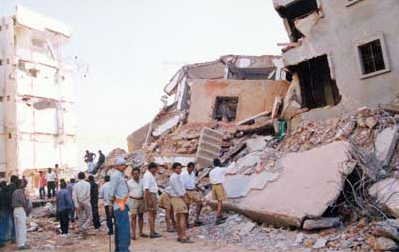
Gujarat’s recovery from the devastating 2001 Kutch earthquake stands as an example of how decisive leadership, effective governance and community participation can transform a disaster-hit region into a resilient society.
The earthquake struck Gujarat at 8:46 a.m. on January 26, 2001, with its epicentre in Kutch, measuring 6.9 on the Richter scale. It affected nearly one crore people across 7,633 villages in 181 talukas, claiming 13,805 lives, including 12,221 in Kutch. Around 1.67 lakh people were injured.More than two lakh houses were completely destroyed, while nearly nine lakh sustained damage.
The disaster also disrupted over 10,000 small and medium industrial units and affected the livelihoods of approximately 50,000 artisans.
Despite the absence of a specific earthquake preparedness plan, local authorities quickly mobilised rescue and relief operations. Communication networks collapsed within an hour, forcing officials to rely on satellite phones and police wireless systems. Medical camps were established, the Army joined rescue operations, and community kitchens were organised.
The Union Government sanctioned Rs. 500 crore for immediate relief on the day of the disaster. Relief materials were also airlifted to affected areas.
Institutional Framework for Reconstruction
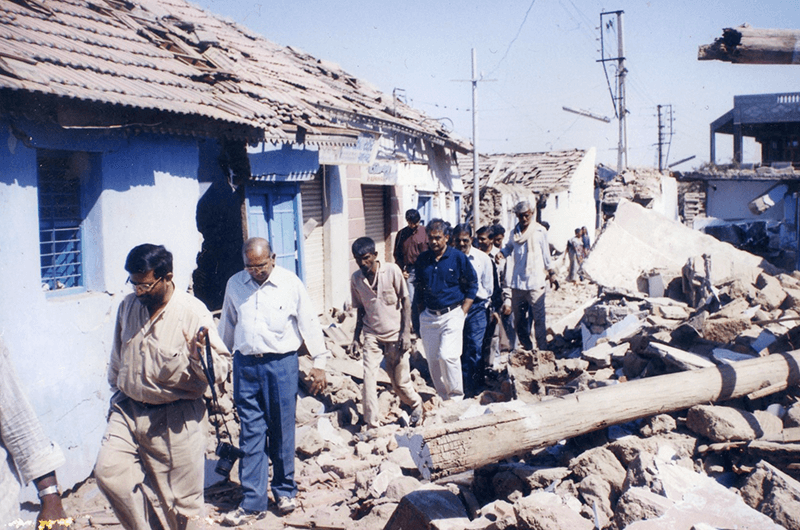
On February 8, 2001, the Gujarat Government established the Gujarat State Disaster Management Authority (GSDMA) to coordinate rehabilitation and reconstruction. Its governing body, chaired by the Chief Minister, adopted a framework that encouraged public participation in rebuilding decisions.
Village committees and Gram Sabhas were involved in decisions regarding the relocation of severely damaged settlements. The authority later received a statutory foundation through the Gujarat State Disaster Management Act, 2003.
A joint assessment by the World Bank and the Asian Development Bank estimated the damage at Rs. 9,909 crore and reconstruction requirements at Rs. 10,575 crore. The state government estimated the cost at Rs. 8,496 crore and contributed approximately Rs. 2,603 crore from its own resources.
Accelerating the Recovery Process
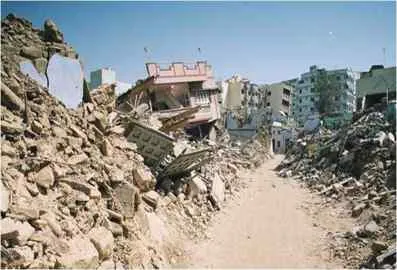
In October 2001, the Chief Minister intensified reconstruction efforts by assigning 11 senior secretaries to the worst-affected talukas. They visited the areas during weekends and submitted progress reports every Monday, with the objective of achieving visible improvements before the earthquake’s first anniversary.
The rehabilitation programme also encouraged families to lead the reconstruction of their own houses. District judges were appointed as ombudsmen to ensure fair consideration of public complaints.
By 2004, approximately 1.87 lakh houses had been rebuilt.The Kutch recovery experience demonstrated the importance of timely decision-making, institutional coordination, transparency and community participation in rebuilding disaster-affected regions.