
M A SUDHEER BABU, PATTAMBI, AGRICULTURAL JOURNALIST
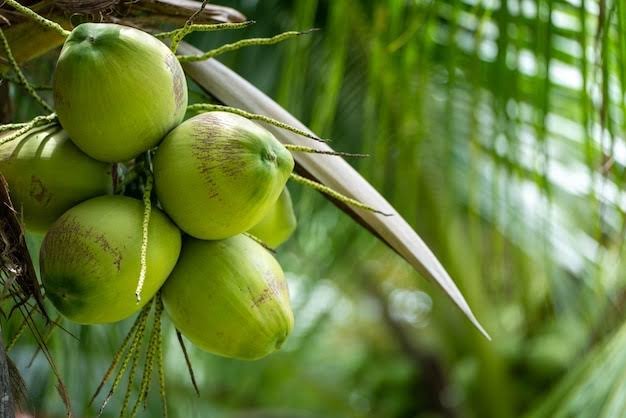
Coconut is one of Kerala’s most important agricultural crops, and achieving a good yield begins with selecting quality seed nuts and healthy seedlings. As the saying goes, a mistake at the seed stage can affect the entire cultivation process. Therefore, farmers planning to start coconut cultivation must pay careful attention to selecting the planting site, mother palms and seed nuts.
Choosing the Right Location
Coconut palms grow best in deep, well-drained soil that can be loosened to a depth of around 1.5 metres. Shallow soil with large underlying rocks is unsuitable for coconut cultivation. Low-lying areas where water stagnates due to poor drainage should also be avoided.
Selecting Healthy Mother Palms
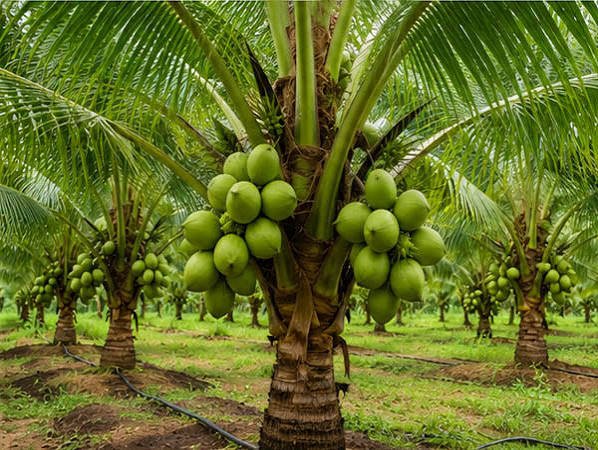
Quality seed nuts should be collected only from healthy and high-yielding mother palms. Ideally, mother palms should be at least 20 years old and consistently produce a minimum of 80 nuts annually.
A good mother palm should have at least 12 healthy bunches, strong leaf stalks and more than 30 fully opened leaves. The palms should have short leaf stalks and sturdy fronds.
The nuts should be medium-sized and oval in shape. Each dehusked nut should weigh at least 600 grams and yield approximately 150 grams of copra.
Seed nuts should preferably be collected from palms that produce good yields even under moderately unfavourable growing conditions, rather than from those that perform well only under highly favourable conditions.
Collection and Storage of Seed Nuts
The ideal period for collecting seed nuts is from December to May. Only fully mature nuts that are more than 11 months old should be selected.
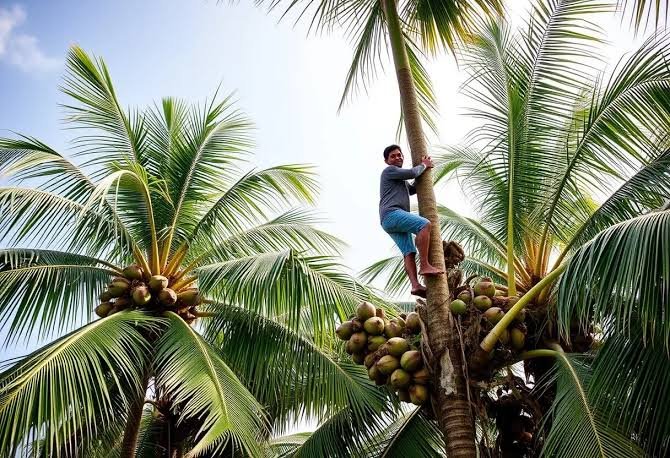
Seed-nut bunches should be lowered carefully using strong ropes to prevent damage. Undersized, lightweight or damaged nuts must be rejected.
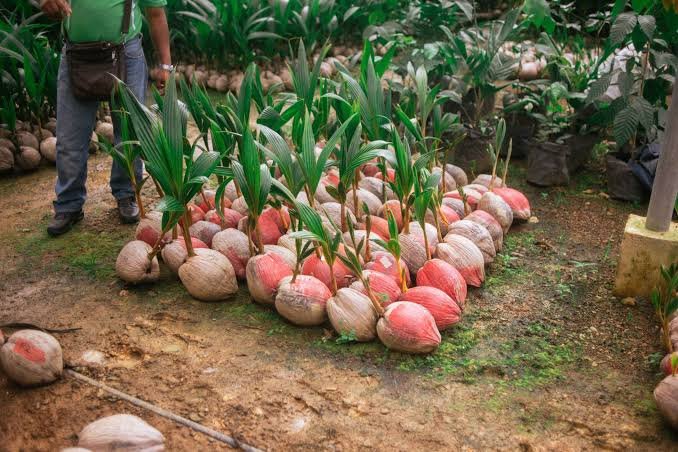
Before germination, the selected seed nuts should be stored in a shaded place for at least two months. The storage area should have a layer of sand approximately eight centimetres thick. The nuts should be arranged with their stalk ends facing upwards and covered with sand. Up to five layers of seed nuts can be stored in this manner.
Preparing the Nursery
A suitable nursery site should have good ventilation, proper drainage, fertile soil and access to irrigation. If the nursery is located in an open area, shade should be provided to reduce direct exposure to sunlight.
Nursery beds should be approximately 1.5 metres wide, with the length adjusted according to the available space. A distance of about 75 centimetres should be maintained between two beds. In areas where water stagnation is likely, raised beds should be prepared.
Seed nuts should be sown during May or June, at the beginning of the southwest monsoon. Appropriate treatments should be applied to prevent termite attacks and rotting.
The recommended spacing is 30 centimetres between rows and 30 centimetres between individual nuts within a row. The nuts should be planted in trenches approximately 25 to 30 centimetres deep, covering them with soil so that only the upper portion remains exposed.
Seed nuts can be planted horizontally with their broader side facing upwards or vertically with the stalk end pointing upwards. Vertical planting makes it easier to remove and transport the germinated seedlings.
Nursery Management and Care
Proper maintenance is essential for healthy seedling development. In sandy soil, irrigation should be provided once every two days during summer. Spraying one per cent Bordeaux mixture is also recommended.
Seed nuts that fail to germinate within six months, as well as damaged and rotten nuts, should be removed from the nursery. Only healthy and well-developed seedlings should be selected for transplantation.
Selecting Seedlings for Transplantation
Seedlings aged between nine and 12 months are generally suitable for planting in the main field.
A one-year-old seedling should have six to eight leaves, while a nine-month-old seedling should have at least four leaves. The girth of the seedling at the collar region should measure approximately 10 to 12 centimetres. Seedlings with well-developed and properly opened leaf stalks should be preferred.
Only vigorous, healthy and well-grown seedlings should be selected for transplantation.
Purchase Seedlings from Reliable Sources
Farmers are advised to purchase quality coconut seedlings from government-approved and recognised institutions. These include Kerala Agricultural University, Department of Agriculture farms, the ICAR-Central Plantation Crops Research Institute and nurseries approved by the Coconut Development Board.
Selecting quality seedlings and ensuring their health before planting are essential steps towards successful coconut cultivation. Poor-quality planting material can result in disappointing yields when the palms begin bearing fruit. Careful selection at the initial stage can therefore make a significant difference to the productivity and long-term profitability of a coconut farm.